 |
QElectroTech 0.200.1-dev
|
|
QElectroTech 0.200.1-dev
|
The EventLoopWatchdog class Detects when the main (GUI) thread's event loop goes unresponsive – QetLogger (discussion #644) can only see what an explicit qDebug()/ qInfo()/qWarning() call already decided to report, and most of a session (painting, dragging, a slow synchronous operation) produces no log output at all, so a silent multi-second gap in the log is indistinguishable from the user simply not doing anything. More...
#include <eventloopwatchdog.h>
Inherits QObject.
Public Member Functions | |
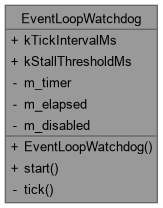
| EventLoopWatchdog (QObject *parent=nullptr) | |
| void | start () |
Static Public Attributes | |
| static constexpr int | kTickIntervalMs = 50 |
| static constexpr int | kStallThresholdMs = 200 |
Private Slots | |
| void | tick () |
Private Attributes | |
| QTimer | m_timer |
| QElapsedTimer | m_elapsed |
| bool | m_disabled = false |
The EventLoopWatchdog class Detects when the main (GUI) thread's event loop goes unresponsive – QetLogger (discussion #644) can only see what an explicit qDebug()/ qInfo()/qWarning() call already decided to report, and most of a session (painting, dragging, a slow synchronous operation) produces no log output at all, so a silent multi-second gap in the log is indistinguishable from the user simply not doing anything.
This closes that gap the direct way: a repeating QTimer::PreciseTimer ticks on a short, fixed interval; each tick measures the actual wall-clock time elapsed since the previous one via QElapsedTimer (monotonic – unaffected by system clock/NTP adjustments, unlike QDateTime). Qt does not queue up missed fires for a normal repeating timer, so if the event loop is blocked for 600ms, the timer fires once as soon as the loop frees up, with ~600ms measured since the last tick – that gap is the stall, measured at its source rather than inferred from log silence.
Only fires a qWarning() (and so only touches the log at all) when a tick is late by more than kStallThresholdMs, to stay within the spirit of QetLogger's bounded-log design (see its class comment) – a healthy session should produce zero output from this class. This tells you that a stall happened and how long it was, not what caused it; pair a reported timestamp with docker exec+gdb the way the CLI hang (PR #661) was diagnosed to go from "it lagged" to a root cause.
Escape hatch: if QET_WATCHDOG_DISABLE=1 is set in the environment at construction time, start() does nothing.
|
explicit |

| void EventLoopWatchdog::start | ( | ) |
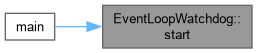
Starts ticking. Must be called from the main thread, after the event loop it watches is about to run (i.e. immediately before QApplication::exec()) – constructing this class earlier is harmless, but start() before there is an event loop to tick against would just measure the time until app.exec() is reached. No-op if QET_WATCHDOG_DISABLE=1 was set at construction time.
|
privateslot |

|
staticconstexpr |
A tick arriving later than this many ms after the previous one is logged as a stall. Comfortably above kTickIntervalMs so ordinary OS scheduling noise doesn't produce a warning on every tick, and in the range a user would actually notice as lag.
|
staticconstexpr |
How often the watchdog checks in. Small enough to bound the measurement's own granularity, large enough that the tick itself is negligible overhead on the event loop it's watching.
|
private |
|
private |
|
private |
 1.15.0